
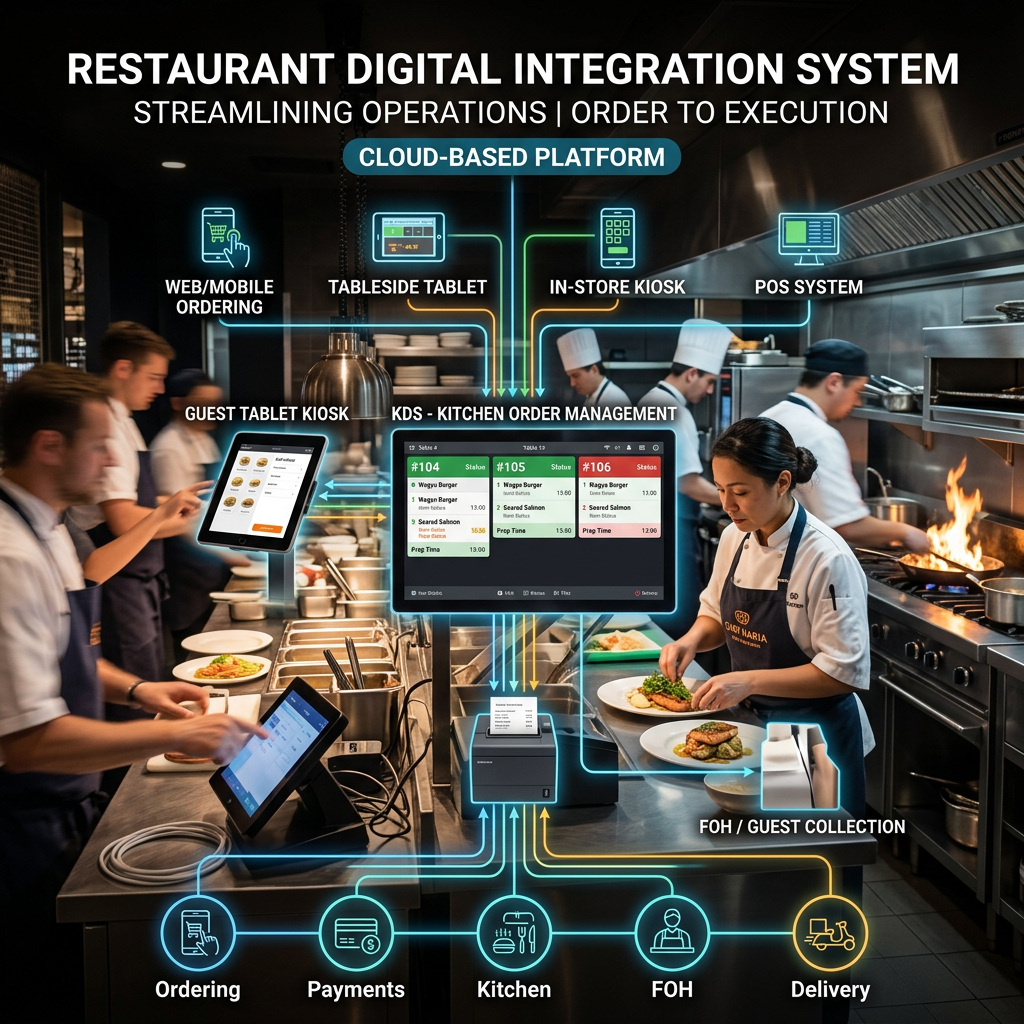
If you run a restaurant or food service business, you’re probably already taking digital orders through some combination of your own website, third-party delivery apps, and an in-store POS system. The problem most operators run into isn’t a shortage of ordering channels — it’s that those channels don’t talk to each other. Menu updates get missed on some platforms. Orders from different sources flow into different systems. Staff manages three tablets instead of one. Olo was built to solve exactly this problem.
What Olo Is
Olo is a digital ordering and delivery platform purpose-built for the restaurant industry. It acts as the connective layer between your digital ordering channels — your website, your app, third-party marketplaces like DoorDash and Uber Eats — and your kitchen operations. Instead of managing orders from multiple disconnected sources, Olo centralizes everything and routes it to your POS or kitchen display system in a consistent format.
Olo works with most major restaurant POS systems — Toast, Square, Aloha, Oracle Micros, and others — which means integration typically doesn’t require replacing your existing infrastructure. It slots in as the digital layer on top of what you already have.
The Core Problem It Solves
The operational friction of disconnected digital ordering is something most restaurant operators deal with daily without necessarily having a name for it. It looks like this:
- You update a menu item’s price or mark something as 86’d in your POS, but the change doesn’t automatically propagate to your website ordering page or your delivery apps
- A customer places an order through DoorDash, another through your website, and a third by phone — each flowing into a different system or tablet on the line
- Your website’s ordering experience is powered by a generic third-party widget that doesn’t match your brand or give you any ownership of the customer relationship
- You have no direct way to remarket to customers who ordered through delivery platforms, because those platforms own the customer data
Olo addresses all of these. Menu management happens in one place and syncs across channels. Orders from all sources arrive in a consistent format at your POS or KDS. Your branded website ordering experience is fully integrated and owned by you. And customers who order directly through your site are your customers — their data is yours to use for marketing and loyalty programs.
How Olo Connects to Your Website
The website integration is where Olo’s value is most visible to customers. Rather than directing website visitors to a third-party ordering page that breaks your brand experience, Olo’s ordering interface can be embedded directly into your website — matching your design, your typography, and your brand voice.
This matters more than it might seem. Studies consistently show that branded, integrated ordering experiences convert better than generic ones. When a customer lands on your website and the ordering flow looks like part of your site — not like they’ve been redirected to a separate service — they’re more likely to complete the order and more likely to return directly next time rather than defaulting to a delivery platform.
The integration also enables features that generic ordering widgets don’t support: loyalty program integration, upsell recommendations based on order history, scheduled ordering for catering and large orders, and group ordering flows where multiple people build a single cart.
Third-Party Marketplace Management
Olo’s Rails product manages your presence on third-party delivery marketplaces — DoorDash, Uber Eats, Grubhub — from a single dashboard. Menu updates push to all connected platforms simultaneously. Order injection routes marketplace orders directly into your POS alongside direct orders, eliminating the separate tablet for each platform.
For operators running on multiple delivery platforms, this alone is often worth the integration cost. The operational savings from not managing separate menus and order streams for each platform, combined with the reduction in errors from manual menu management, add up quickly at any meaningful order volume.
Customer Data and Marketing
One of the most underappreciated aspects of direct ordering through your own website — powered by Olo — is the customer data it generates. Every direct order captures a customer email, order history, preferences, and frequency data that you own entirely. This is the foundation of a loyalty program, an email marketing strategy, and the kind of personalized reorder experience that keeps customers coming back without relying on a delivery platform as the intermediary.
Olo integrates with marketing platforms and CRM systems, which means that customer data can flow into email automation tools — triggering win-back campaigns for lapsed customers, suggesting reorders based on past history, or promoting new menu items to customers who’ve ordered similar things before. This is the restaurant equivalent of the MarTech stack that e-commerce stores use, applied to food service operations.
Who Olo Is Best Suited For
Olo is primarily used by multi-location restaurant groups and regional chains — operations with enough order volume and complexity that centralized management delivers clear ROI. It’s built for scale, with enterprise-grade reliability for high-volume ordering environments.
Single-location independent restaurants may find that simpler solutions meet their needs more cost-effectively. But for growing restaurant groups — particularly those operating across multiple locations with inconsistent digital ordering infrastructure — Olo provides the kind of operational standardization that makes expansion manageable.
What the Integration Work Actually Involves
Getting Olo integrated with your website isn’t a plugin install. It requires connecting Olo’s API to your website, embedding the ordering interface in a way that matches your brand, configuring your menu structure within Olo, connecting your POS integration, and testing the complete order flow across all channels before going live.
The website side of this is a development project. Done well, the result is an ordering experience that feels like a native part of your site rather than a third-party widget. Done poorly, it creates a disjointed experience that undermines the brand investment you’ve made in the rest of your digital presence.
Building the Integration Right
At Interactive Design Group, we work with restaurant operators to integrate Olo with their websites — building ordering experiences that are on-brand, properly connected to their POS, and set up to capture the customer data that powers their marketing programs. If you’re running a restaurant group that’s dealing with the operational friction of disconnected digital ordering, get in touch — we’ll walk you through what a properly integrated setup looks like and what it would take to get there.