
ADA compliance isn’t a topic most e-commerce store owners think about until something forces them to. That something is usually a demand letter from a law firm — and by that point, you’re already looking at legal fees, potential settlements, and an urgent remediation project. Getting ahead of it is significantly cheaper and less stressful than dealing with it reactively.
Here’s what ADA compliance means for your WooCommerce store, what the legal exposure actually looks like, and what fixing it involves.
What ADA Compliance Means for Websites
The Americans with Disabilities Act was passed in 1990, long before e-commerce existed. Courts and the Department of Justice have since interpreted it to apply to websites — ruling that online stores serving the public are “places of public accommodation” subject to ADA requirements.
In practice, web accessibility standards are defined by the Web Content Accessibility Guidelines — WCAG — currently at version 2.1. WCAG 2.1 Level AA is the benchmark most courts and legal frameworks reference when evaluating whether a website is accessible. It covers four core principles: content must be perceivable, operable, understandable, and robust — meaning it works across assistive technologies like screen readers.
The Legal Reality
ADA web accessibility lawsuits have increased substantially over the past several years. Plaintiffs’ law firms run automated scans across thousands of websites, identify accessibility failures, and send demand letters at scale. E-commerce sites are frequent targets because the legal theory is straightforward — if a blind customer can’t use your checkout, they’re being denied access to your store in a way a sighted customer isn’t.
Settlements typically range from a few thousand dollars to tens of thousands, plus legal fees on both sides, plus the cost of remediation you have to do anyway. Companies that fight these cases sometimes win, but the litigation cost often exceeds the settlement cost regardless of outcome. The practical calculus for most small businesses points clearly toward getting compliant before a claim arrives.
Common Accessibility Failures on WooCommerce Sites
Automated accessibility scanners catch a predictable set of issues on most WooCommerce stores. The most frequently cited:
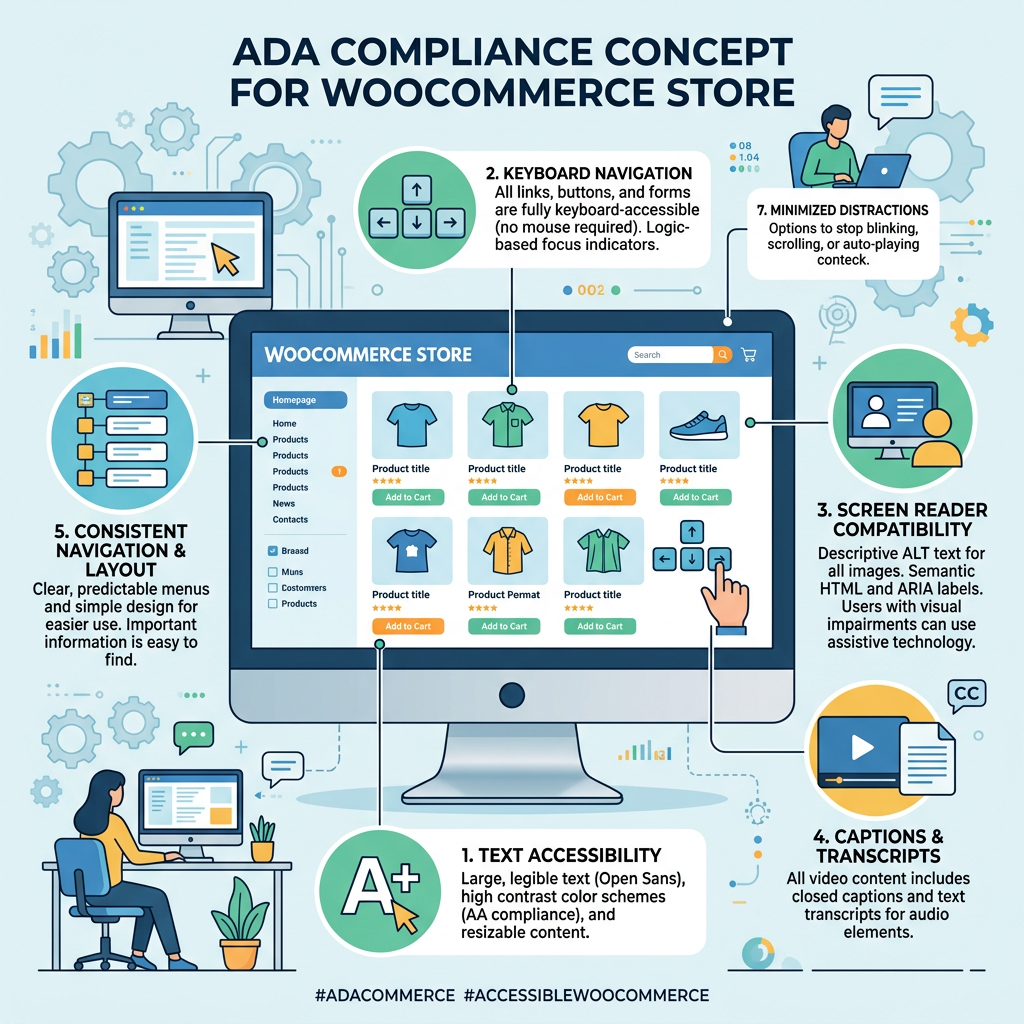
- Missing image alt text. Every image needs descriptive alternative text so screen readers can communicate what it shows. Product images without alt text make your catalog unusable for visually impaired customers.
- Insufficient color contrast. Text needs to meet minimum contrast ratios against its background — 4.5:1 for normal text, 3:1 for large text under WCAG 2.1 AA. Low-contrast text fails both users with low vision and automated audits.
- Form fields without labels. Every input in your checkout — name, address, card number — needs a properly associated label element. Placeholder text alone doesn’t satisfy this requirement because it disappears when the user starts typing.
- Non-keyboard-navigable elements. Every interactive element on your site — buttons, links, dropdown menus, the add to cart button — needs to be reachable and operable using only a keyboard. Users who can’t use a mouse depend on this.
- Missing focus indicators. When keyboard users tab through a page, there should be a visible indicator showing which element is currently focused. Many themes suppress this for aesthetic reasons, which is an accessibility failure.
- Videos without captions. Any video content needs accurate captions for users who are deaf or hard of hearing.
- PDFs and downloadable documents. Product spec sheets, instructions, and other documents need to be accessible or have accessible alternatives.
Why WooCommerce Stores Have Specific Challenges
WooCommerce introduces accessibility complexity beyond a standard WordPress site. The checkout flow — one of the most legally scrutinized parts of an e-commerce site — involves dynamically updated content, AJAX requests, error messages, and multi-step processes that need to work correctly with screen readers. Many WooCommerce themes and plugins weren’t built with accessibility as a priority, which means issues often run deeper than surface-level fixes.
Payment gateway integrations introduce third-party content that may have its own accessibility issues. Product variation selectors, quantity inputs, and cart update mechanisms all need to communicate state changes to assistive technologies correctly. A site that looks fine visually can still be completely inaccessible to a screen reader user if the underlying markup and ARIA attributes aren’t correct.
What an Accessibility Audit Actually Involves
Automated scanning tools — Axe, WAVE, Lighthouse — catch roughly 30–40% of accessibility issues. The rest require manual testing, including actual keyboard navigation testing and screen reader testing with tools like NVDA, JAWS, or VoiceOver. A legitimate accessibility audit combines both automated scanning across all key pages and manual testing of critical user flows — particularly the purchase path from product page through checkout confirmation.
The audit produces a prioritized remediation list. Not all issues carry equal legal weight or user impact — a missing alt text on a decorative image is different from a checkout button that’s unreachable by keyboard. Prioritization focuses remediation effort where it matters most.
Remediation: What Getting Compliant Actually Takes
Some accessibility fixes are straightforward — adding alt text to images, fixing color contrast in CSS, adding labels to form fields. Others require theme-level or plugin-level changes that a non-developer can’t make safely. Checkout accessibility issues in particular often require code-level intervention.
One thing worth knowing: accessibility overlays and widgets — the AI-powered accessibility tools that promise instant compliance through a JavaScript snippet — do not make your site compliant. They’re increasingly being named in lawsuits themselves because they don’t fix the underlying code, they layer on top of it in ways that often create new problems for screen reader users. Courts have been unimpressed by them as a compliance strategy. Real remediation means fixing the actual code.
Accessibility Is Also Good for Business
Beyond the legal case, accessibility improvements genuinely make your store better for everyone. Clearer labels improve usability for all customers. Better color contrast helps users in bright sunlight on mobile. Keyboard navigation improvements benefit power users. Faster, cleaner markup tends to improve Core Web Vitals scores. The customer base with disabilities in the US represents significant purchasing power — an accessible store serves them where an inaccessible one doesn’t.
Getting Your WooCommerce Store Compliant
At Interactive Design Group, we conduct WCAG 2.1 AA accessibility audits on WooCommerce stores and handle the remediation — from surface-level fixes through checkout flow and theme-level code corrections. We document what we find, prioritize by risk and impact, and produce a remediated site that holds up to both automated scanning and manual testing.
If you haven’t had your WooCommerce store audited for accessibility, get in touch. It’s a much better conversation to have now than after a demand letter arrives.