
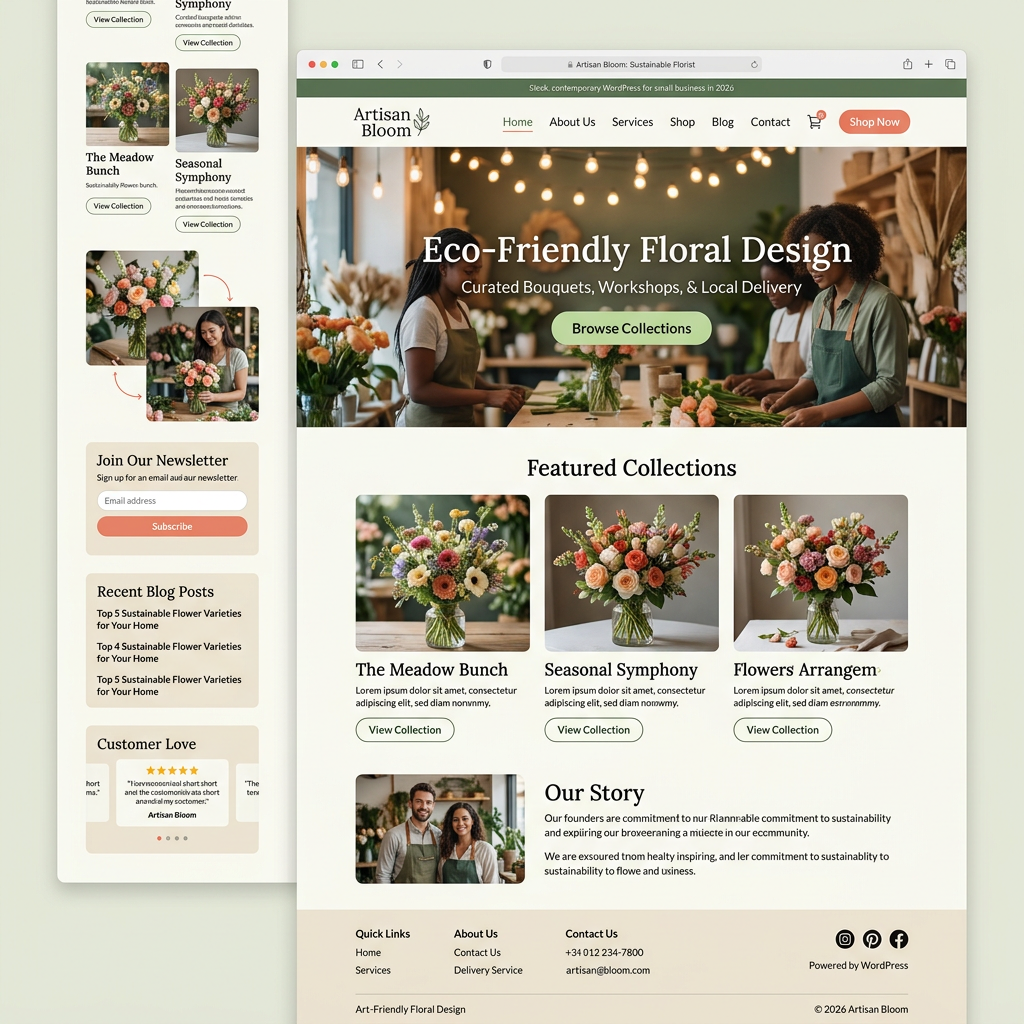
With so many website platforms competing for your attention in 2026 — Wix, Squarespace, Shopify, Webflow, and more — you might be wondering whether WordPress is still worth it once you’re past the startup stage. The answer, for most established and scaling businesses, is an emphatic yes. Here’s why WordPress remains the smartest platform choice in 2026, and why that’s unlikely to change anytime soon.
WordPress by the Numbers
WordPress powers over 43% of all websites on the internet — more than any other platform by a wide margin. That’s not a legacy stat from a decade ago; it’s the current reality in 2026, and that market share has only grown over time. When nearly half the web runs on a platform, it’s not a trend. It’s infrastructure.
More importantly, WordPress powers websites for organizations of every size — from solo consultants to Fortune 500 companies. That range matters, because it means the platform scales with you as your business grows, without forcing a painful platform migration at some arbitrary size threshold.
1. You Own Everything
This is the most fundamental advantage of WordPress, and it’s one that business owners often don’t fully appreciate until they’ve been burned by a proprietary platform — or until legal or procurement asks who actually owns the infrastructure the company depends on.
WordPress is open-source software. You install it on your own hosting account, on a domain you control. Your content, your design, your data — all of it belongs to you. If you ever want to switch hosting providers, change developers or agencies, or move platforms entirely, you can. No one can take your website away, raise your prices arbitrarily, or shut down the platform your business runs on.
Compare that to Wix or Squarespace, where your website lives on their servers, in their proprietary format. If they change their pricing, discontinue a feature, or shut down entirely, you have limited options — a real risk to weigh as more of your operations depend on the site.
2. Unmatched Flexibility
WordPress can be almost anything. A corporate site with dozens of department and product pages. A multi-location business with location-specific content and online ordering. A membership community with gated content. A full-featured e-commerce store with thousands of products across multiple warehouses. A portfolio, a blog, a booking system, a directory — often all at once, and often all needing to scale together as the organization grows.
This flexibility comes from WordPress’s ecosystem of over 60,000 plugins and thousands of themes. Need appointment booking? There’s a plugin for that. Need to accept recurring payments? Done. Need to connect your website to your CRM, ERP, email marketing platform, or inventory system? There’s almost certainly an integration available — and where there isn’t, WordPress’s open architecture makes custom integration straightforward for a competent developer.
No other platform comes close to this level of extensibility without requiring true enterprise-level budgets.
3. WooCommerce Scales With Complex Operations
If you sell products online — or plan to — WordPress paired with WooCommerce is one of the most powerful combinations available at any price point. WooCommerce powers roughly 37% of all online stores worldwide, and for good reason.
Unlike Shopify, which charges transaction fees and limits your customization unless you pay for higher tiers, WooCommerce gives you complete control over your store with no per-transaction fees to the platform. You own your customer data, your product catalog, and your checkout experience — which matters more, not less, as order volume and customer data grow into a genuine business asset.
4. SEO Advantages Are Built In
WordPress is inherently SEO-friendly — it generates clean, semantic HTML, supports fast page loads when properly configured, and integrates seamlessly with powerful SEO plugins like Yoast SEO and Rank Math. These tools give businesses access to the same level of on-page optimization that the largest enterprise teams use, without needing to buy a separate enterprise SEO platform.
You can control every meta title, meta description, canonical tag, schema markup, sitemap, and robots directive without touching code, at scale across hundreds or thousands of pages. That level of control simply isn’t available on most drag-and-drop website builders.
5. A Massive Talent Pool
Because WordPress is so widely used, there are more developers, designers, and agencies with WordPress expertise than any other platform. That means more competition, which generally means better pricing and more options when you need help — whether that’s a specialized agency, an in-house hire, or a mix of both as your needs evolve.
It also means that if you ever part ways with your current developer or agency, finding a qualified replacement is straightforward. You’re not dependent on a single specialist who knows a niche proprietary system — you can work with virtually any WordPress development agency in the world.
6. Content Management That Scales Across a Team
One of the biggest frustrations business owners have with their websites is not being able to update them without calling a developer — and that frustration compounds when multiple departments or contributors need to publish content independently. WordPress’s block editor (Gutenberg), combined with a proper user role structure, makes it genuinely easy for non-technical users across an organization to add content, update pages, and manage their own sections without stepping on each other.
When I build a WordPress site for a client, one of the standard deliverables is training and role setup so the team can manage their own content confidently — including permission structures for larger teams with multiple content owners. That independence is something most organizations value highly once they experience it.
7. Cost Efficiency Over Time
WordPress itself is free. Your costs are hosting (typically $20–$100+/month for quality managed hosting, more at higher traffic tiers), your domain, and any premium plugins or themes you choose. Compare this to platforms that charge $50–$300+/month for equivalent features, plus transaction fees on sales, plus premium add-ons for things WordPress handles natively.
Over a 3–5 year period, a well-built WordPress site is almost always more cost-effective than a comparable setup on a proprietary platform — and you have far more to show for it in terms of ownership and flexibility, which matters increasingly as the site becomes a bigger part of the business.
Is WordPress Right for Every Business?
WordPress is the right choice for the vast majority of businesses — but it’s worth being honest about when it might not be. If you need an extremely simple one-page site and never plan to grow it, a basic website builder might be faster and cheaper to set up. If you’re running an extremely large enterprise store with deep ERP integrations and complex custom logic, a more specialized platform might fit better in specific cases.
But for the typical growing or established business that needs a professional website with good SEO, the ability to scale, reliable performance, and content a team can manage themselves? WordPress in 2026 is still the answer.
Ready to Build on WordPress?
At Interactive Design Group, I’ve been building custom WordPress websites for businesses nationwide since 2002. I know the platform inside and out — from initial strategy and architecture through launch, SEO setup, and ongoing support at scale.
Contact me for a free consultation — let’s talk about what the right WordPress setup looks like for your business.