
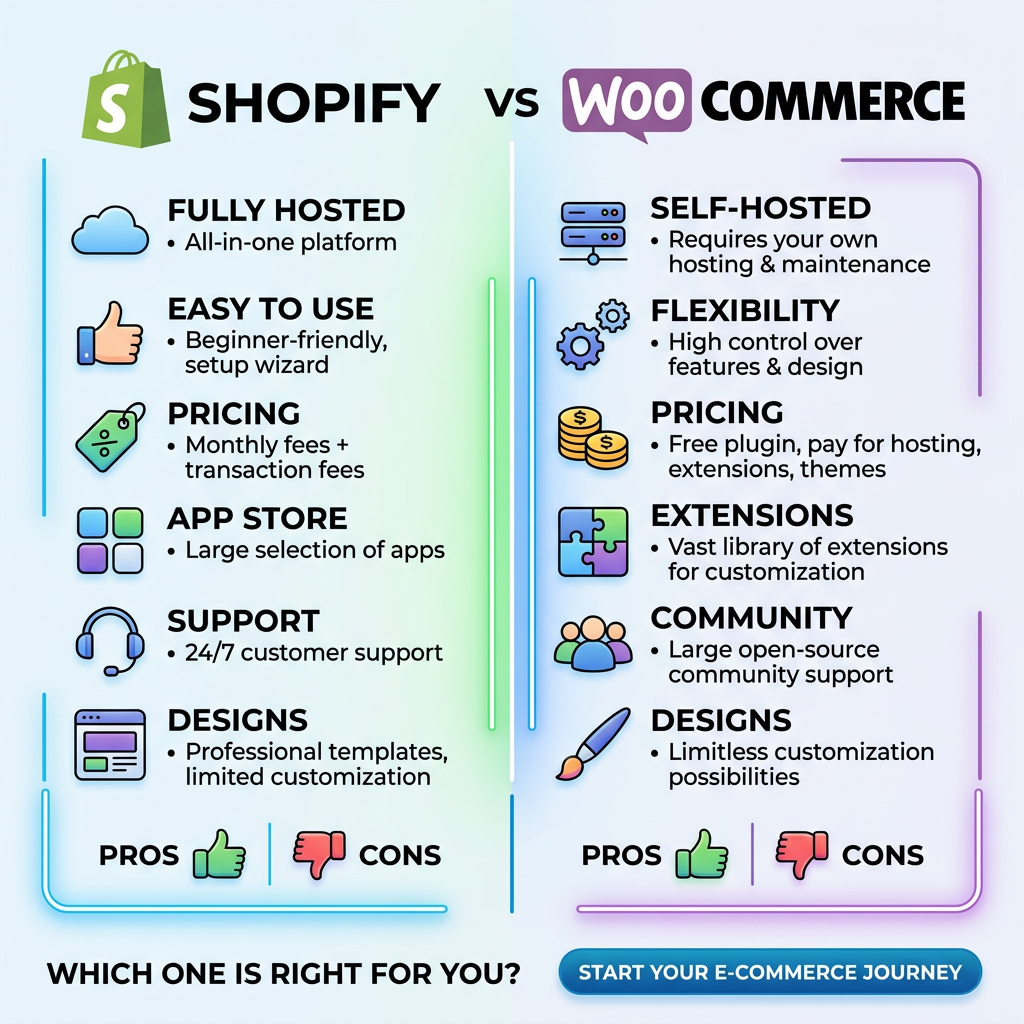
WooCommerce vs Shopify: Which Is Right for Your Business in 2026?
If you’re thinking about launching an online store — or upgrading the one you already have — you’ve almost certainly landed in the middle of the WooCommerce vs Shopify debate. Both platforms power millions of online stores worldwide, and both have genuine strengths. But they’re built for very different types of businesses and business owners.
After 20+ years of building websites and e-commerce solutions for businesses across Florida and beyond, we’ve helped hundreds of clients make exactly this decision. Here’s what we’ve learned — and what we wish more business owners knew before they chose.
The Short Answer
Choose Shopify if you want a hosted, all-in-one solution that’s fast to launch, easy to manage yourself, and doesn’t require a developer on speed dial.
Choose WooCommerce if you want full control over your store, lower long-term costs, stronger SEO capabilities, and a platform that can grow and adapt to your exact business — without being constrained by a monthly platform fee.
1. Cost: What You’ll Actually Pay
Shopify
Shopify’s pricing looks simple at first glance — plans start at around $39/month. But the real number is higher once you factor in:
Annual costs can easily reach $1,500–$3,000+ once necessary apps are added
Transaction fees (0.5%–2% per sale unless you use Shopify Payments)
Premium themes ($150–$400 one-time)
Apps for features WooCommerce includes natively (subscriptions, advanced shipping, B2B pricing, custom fields)
WooCommerce
WooCommerce itself is free — it’s an open-source plugin for WordPress. Your real costs are hosting ($20–$100/month for quality managed WordPress hosting), domain (~$15/year), and any premium plugins needed. Zero platform transaction fees on your sales.
Bottom line: WooCommerce typically costs significantly less over a 3–5 year horizon, especially as your sales volume grows.
2. Ease of Use
Shopify wins here — it’s clean, intuitive, and designed for non-technical users. WooCommerce has more moving parts but far more flexibility. Most of our clients who use WooCommerce choose to work with a developer for setup and maintenance — and the ROI on that investment is significant.
Bottom line: If you truly want to run everything yourself with no tech help, Shopify is more accessible. If you plan to work with a developer, WooCommerce’s learning curve is a non-issue.
3. Customization & Flexibility
Shopify is a closed platform — you can customize what Shopify allows. WooCommerce is fully open-source, meaning virtually unlimited customization: custom checkout flows, complex B2B pricing, unique product configurators, and integrations with any CRM, ERP, or booking system.
Bottom line: For businesses with specific operational needs, WooCommerce is the clear winner.
4. SEO Capabilities
WooCommerce runs on WordPress — the most SEO-friendly CMS ever built. Combined with plugins like Yoast SEO or Rank Math, you get complete control over every SEO element: custom URL structures, schema markup, breadcrumbs, XML sitemaps, page speed optimizations, and more. Shopify has improved its SEO but still has structural limitations around URL structures and duplicate content that can hold back your rankings.
Bottom line: If organic search traffic is important — and for most small businesses it’s the highest-value channel — WooCommerce has a meaningful SEO advantage.
5. Ownership & Portability
Your Shopify store lives on Shopify’s servers. If you decide to leave, migrating is complex and costly. Your WooCommerce store is yours — the files, database, product data, and customer records all live on your hosting server and can be moved, backed up, and controlled however you choose.
Bottom line: For business owners who think long-term, ownership matters. WooCommerce gives you full control of your digital asset.
Side-by-Side Comparison
| Factor | WooCommerce | Shopify |
| Platform cost | Free (hosting ~$20–100/mo) | $39–$399/mo |
| Transaction fees | None | 0.5%–2% |
| Ease of use | Moderate | Beginner-friendly |
| Customization | Unlimited | Moderate |
| SEO capability | Excellent | Good |
| Data ownership | Full ownership | Platform-hosted |
| Payment gateways | All major, no extra fees | All (fees apply) |
| Best for | Growth-focused businesses | Simple stores, quick launches |
What About Migrating from Shopify to WooCommerce?
We handle Shopify-to-WooCommerce migrations regularly — full product catalog transfers, URL redirects to preserve your search rankings, and design recreation in WordPress. The process typically takes 4–6 weeks and the long-term savings often pay for the migration cost within the first year.
Our Recommendation
For the vast majority of small and medium-sized businesses we work with — especially those in Florida’s competitive restaurant, hospitality, health & beauty, and industrial sectors — WooCommerce is the stronger long-term platform. The combination of zero platform fees, superior SEO capabilities, unlimited customization, and full data ownership creates a foundation for genuine, sustainable growth.
Ready to Build or Migrate Your Online Store?
Interactive Design Group has been building WooCommerce stores for businesses across Florida for over 30 years. Whether you’re starting fresh or migrating from another platform, we handle everything — design, development, payment integration, SEO setup, and launch support.
Get a free WooCommerce consultation today — no obligation, just a straight conversation about what’s right for your business.
[info@interactive-design-group.com] | interactive-design-group.com/contact
Interactive Design Group is a custom web development agency based in Altamonte Springs, FL, specializing in WordPress, WooCommerce, and managed hosting solutions for businesses across Florida and the United States.