
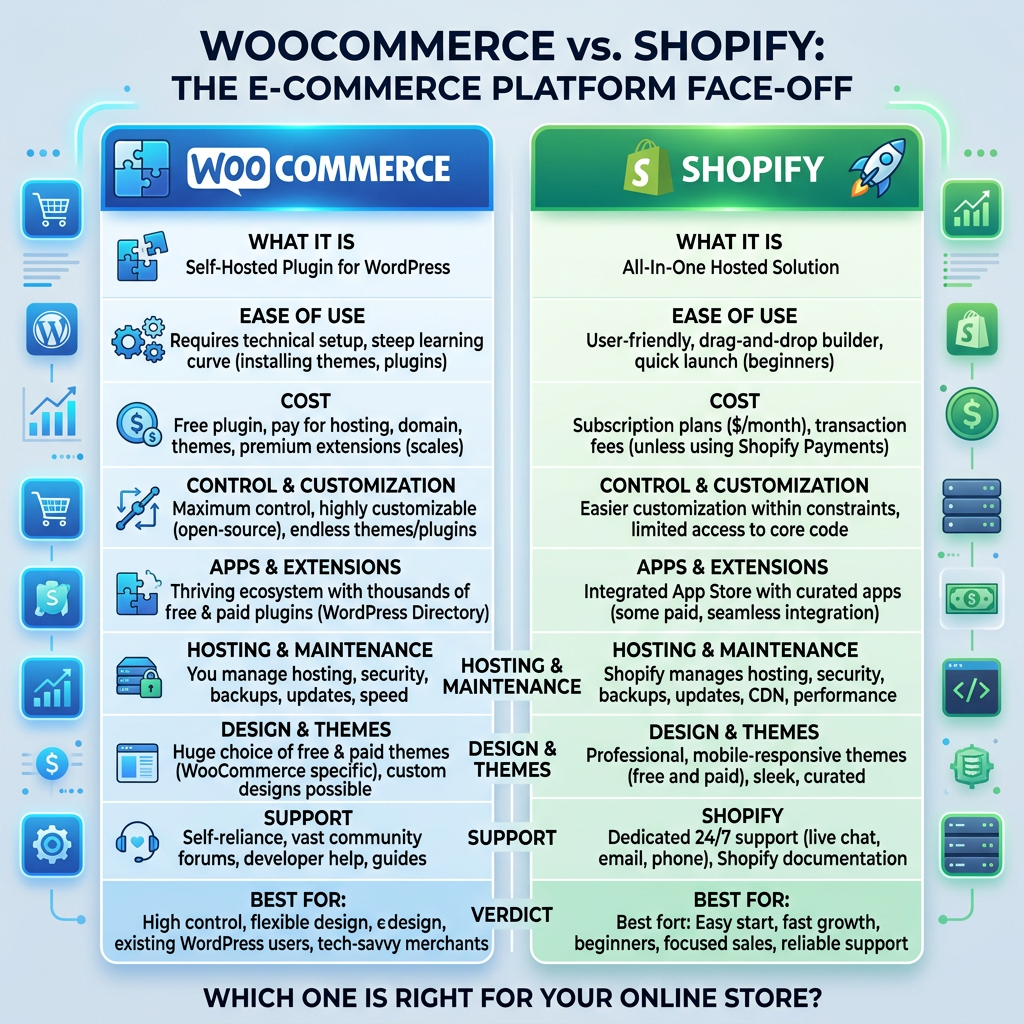
If you’re building an online store, at some point you’ve landed on this question: WooCommerce or Shopify? Both are legitimate platforms used by millions of stores. But they’re built on fundamentally different philosophies, and the right choice depends heavily on how you run your business and where you want to take it.
Here’s an honest comparison — not a sponsored rundown, just the actual trade-offs.
Ownership and Control
This is the most fundamental difference between the two platforms, and it shapes everything else.
Shopify is a hosted, closed platform. Your store lives on Shopify’s servers, runs on Shopify’s software, and operates within Shopify’s rules. That’s convenient — but it means Shopify can change its pricing, modify its terms, deprecate features, or in extreme cases shut down your store. You’re a tenant, not an owner.
WooCommerce is open-source software that runs on WordPress, which you host yourself. Your store, your data, your server, your rules. You can move hosts, switch developers, export everything, and modify any part of the codebase. Nobody can take it away from you or change the terms of your tenancy because there is no tenancy.
If ownership matters to you — and for most serious businesses it should — WooCommerce has a structural advantage that no feature comparison can offset.
Setup and Ease of Use
Shopify wins here, and it’s not close. You can have a basic store live in an afternoon without any technical knowledge. The interface is clean, the onboarding is guided, and most common tasks are straightforward.
WooCommerce has a steeper learning curve. You’re managing WordPress, hosting, plugins, updates, and backups as separate considerations. For someone without technical experience, that overhead is real. It’s manageable — millions of non-technical people run WooCommerce stores — but it requires either more learning or a developer relationship.
The counterpoint: Shopify’s simplicity has a ceiling. Things that are easy on Shopify stay easy right up until you need something slightly outside the standard playbook, at which point you hit walls fast.
Cost: The Real Numbers
Shopify’s pricing looks straightforward: plans start at $39/month and go up to $399/month for their standard tiers. But that’s before you add the apps you actually need. Most real stores end up spending $50–$200/month on apps on top of their plan fee. And if you use a third-party payment gateway instead of Shopify Payments, you pay an additional transaction fee on every sale — 0.5% to 2% depending on your plan.
WooCommerce itself is free. Your costs are hosting ($20–$100/month for quality managed WordPress hosting), your domain, and any premium plugins you choose. There are no per-transaction fees to the platform — ever. Payment gateway fees go to Stripe or PayPal directly, same as Shopify when using third-party processors.
Over three to five years, a well-run WooCommerce store is almost always meaningfully cheaper than an equivalent Shopify store, especially as volume grows.
Customization and Flexibility
Shopify’s theme and app ecosystem is solid. You can customize a lot within the bounds of what Shopify allows. But those bounds exist. Deep customization — particularly in checkout — has historically required Shopify Plus (their enterprise tier at $2,000+/month). Shopify has opened some of this up recently, but the platform still has structural limits that you’ll eventually run into if your needs are specific enough.
WooCommerce has essentially no ceiling on customization. If you can describe it, a developer can build it. Custom checkout flows, unconventional product types, complex pricing rules, membership-gated content, multi-vendor marketplaces — all of it is possible because you have access to the full codebase and a plugin ecosystem of over 60,000 options.
SEO
Both platforms are SEO-capable. But WooCommerce — running on WordPress — has a structural SEO advantage. WordPress was built with content publishing as a core function, and it shows. You get granular control over every SEO element, deep integration with tools like Yoast SEO, and the ability to build out a content strategy (blog, guides, landing pages) that sits natively alongside your store rather than being awkwardly bolted on.
Shopify’s SEO has improved considerably, but there are still structural quirks — URL structure limitations, duplicate content issues with certain configurations — that require workarounds. Not dealbreakers, but friction points that don’t exist on WooCommerce.
Scalability
Shopify scales easily from a technical standpoint — you’re not managing infrastructure, so traffic spikes and catalog growth are largely Shopify’s problem to handle. That’s genuinely useful.
WooCommerce scales well too, but it requires more intentional infrastructure decisions as you grow. The right hosting plan, proper caching, a CDN, database optimization — these matter at scale and require either knowledge or a developer. The upside is that you have full control over your infrastructure and aren’t dependent on a platform’s pricing decisions as your volume grows.
When Shopify Makes Sense
- You want to get a store live quickly with minimal technical involvement
- Your product catalog is relatively standard and you don’t need unusual customization
- You don’t have (or want) a developer relationship for ongoing technical management
- You’re primarily selling on social media or marketplaces alongside your store, where Shopify’s integrations are strong
When WooCommerce Makes Sense
- Ownership and data portability matter to your business
- You want genuine control over your checkout and customer experience
- You’re building a content-driven store where SEO and blogging are part of your strategy
- Your product or pricing model is non-standard and requires custom functionality
- You’re cost-sensitive over the long term and want to avoid platform fees and app subscriptions
- You already have a WordPress site and want to add e-commerce
The Bottom Line
Shopify is a better fit for people who want simplicity and are willing to trade control and long-term cost efficiency to get it. WooCommerce is a better fit for businesses that want to own their platform, customize their experience, and build something that isn’t constrained by a third party’s roadmap decisions.
Neither is universally better. But if you’re asking a developer who’s worked with both extensively, most serious long-term e-commerce businesses end up better served by WooCommerce.
At Interactive Design Group, we build custom WooCommerce stores designed around how your business actually works. If you’re trying to decide which platform is right for your project, get in touch — we’ll give you an honest answer based on your specific situation.