
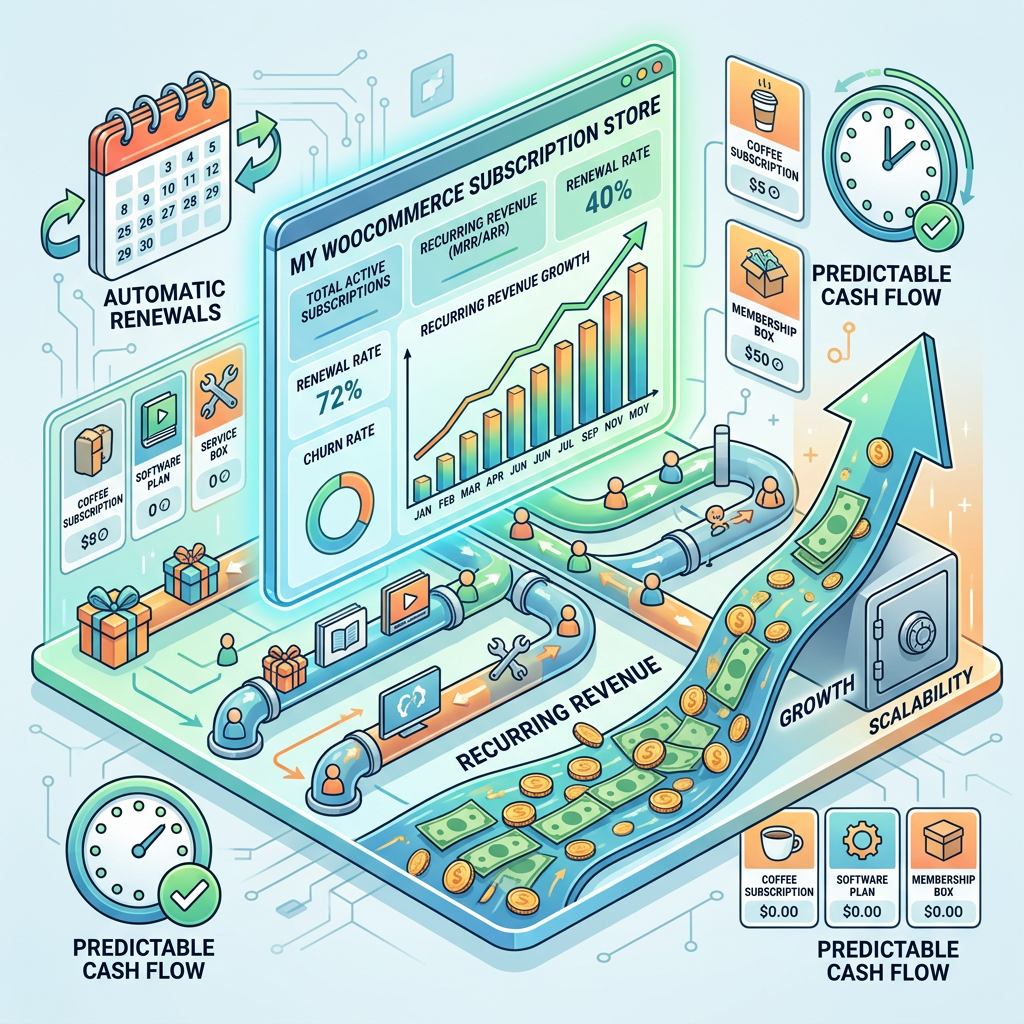
Recurring revenue changes the math of running a business. Instead of chasing new customers every month to hit your numbers, a well-built subscription model creates a compounding revenue base that grows as you retain customers and add new ones. The businesses that get this right don’t just generate more revenue — they build something predictable, scalable, and far more valuable than a transactional store.
But the difference between a subscription model that works and one that quietly costs you money comes down almost entirely to how it’s built. Here’s what decision-makers need to understand before investing in a WooCommerce subscription build.
The Business Case for Subscription Revenue
Subscription businesses command higher valuations, attract more predictable cash flow, and create deeper customer relationships than transactional models. For B2B operators specifically, recurring billing aligns revenue to ongoing service delivery — maintenance retainers, software access, replenishment programs, managed services — in a way that one-time invoicing doesn’t.
WooCommerce handles this model well. When it’s built correctly, the platform manages automatic billing, renewal notifications, failed payment recovery, and subscriber self-service without manual intervention. Your team manages exceptions; the system handles the routine.
When it’s built incorrectly, you get the opposite — billing failures that go unnoticed, subscriber data that doesn’t match your records, payment gateway conflicts that emerge at the worst possible moments, and a customer experience that erodes trust in your brand every renewal cycle.
What a Properly Built Subscription System Handles
A professional WooCommerce subscription implementation manages significantly more than recurring charges. The billing logic — automatic renewals, prorated upgrades and downgrades, trial period management, sign-up fees — needs to be configured correctly for every pricing scenario your business offers. Payment gateway integration needs to support tokenized recurring billing and handle the edge cases that come up in real-world operations: cards that expire mid-subscription, banks that flag recurring charges, customers who update payment methods mid-cycle.
Failed payment recovery deserves particular attention. Passive churn — subscribers whose payments fail and who don’t actively cancel — is one of the primary revenue leaks in subscription businesses. A properly built system includes automated dunning sequences through Klaviyo, retry logic configured to your billing cycle, and clear communication pathways that recover a significant percentage of failed renewals before the subscription lapses. Stores without this infrastructure lose revenue silently every month.
The Integration Layer Matters as Much as the Store
A subscription store in isolation captures recurring payments. A subscription store connected to your broader business infrastructure creates operational leverage. The difference is in how your WooCommerce data flows to the systems around it.
Subscriber data synced to your CRM means your sales and customer success teams have current information without manual exports. Klaviyo connected to subscription events means your marketing automation responds to subscriber behavior — upgrade prompts when engagement signals warrant them, win-back sequences for cancelled subscribers, loyalty communications for long-term customers. GTM event tracking on subscription interactions means you understand the full funnel economics of your acquisition spend.
These integrations are standard components of a well-built subscription stack. They’re also the components that get deprioritized or skipped in underpowered builds — and their absence shows up in revenue data within a few billing cycles.
What Gets Expensive When It’s Done Wrong
Subscription infrastructure built without proper technical oversight creates problems that compound over time. A payment gateway that doesn’t properly support recurring billing works fine in testing and fails in production. Subscription data that doesn’t sync correctly to fulfillment systems creates order errors that require manual intervention at scale. A checkout flow that isn’t optimized for subscription conversion loses prospects at the moment of highest intent.
Rebuilding subscription infrastructure on a live store — with active subscribers, billing history, and payment methods on file — is significantly more complex and expensive than building it correctly the first time. Migration risk, subscriber communication, billing cycle coordination, and data integrity all become constraints that a greenfield build doesn’t have.
What the Right Build Looks Like
The businesses that get the most from WooCommerce subscriptions are the ones that treat the build as a revenue infrastructure project, not a plugin installation. The technical implementation — gateway configuration, billing logic, failure handling, integration setup — is the foundation. The marketing infrastructure built on top of it — Klaviyo flows, GTM tracking, CRM sync — is what turns that foundation into compounding revenue growth.
At Interactive Design Group, we build WooCommerce subscription stores as complete systems — not just the store, but the billing infrastructure, the MarTech integrations, and the operational workflows that make them run without constant manual intervention. If you’re evaluating a subscription model for your business or looking to rebuild subscription infrastructure that isn’t performing, get in touch. We’ll assess your specific situation and tell you what a properly built system would look like for your business.