
When an operations manager or a director of marketing calls me about a WordPress project, the question underneath the question is almost never “can WordPress do this.” It’s “can this platform, and whichever agency we hire to run it, hold up once we’re not the only stakeholder in the room anymore.” That’s a fair question, and it deserves a straight answer instead of a sales pitch.
The Real Question Isn’t the CMS
WordPress runs a large share of the web, including plenty of sites operating at real scale — multi-location businesses, franchises, companies with marketing, sales, and IT all touching the same site. The platform isn’t the risk. The risk is almost always the agency relationship built on top of it: undocumented customizations, a single developer who understands the codebase, no real staging process, and no plan for what happens when your team’s needs outgrow a template.
So when I talk to decision-makers vetting agency partners, I push the conversation away from “what CMS should we use” and toward “what does this agency’s operating model actually look like once we’re a live client, not a pitch.”
What to Actually Ask an Agency Before You Sign
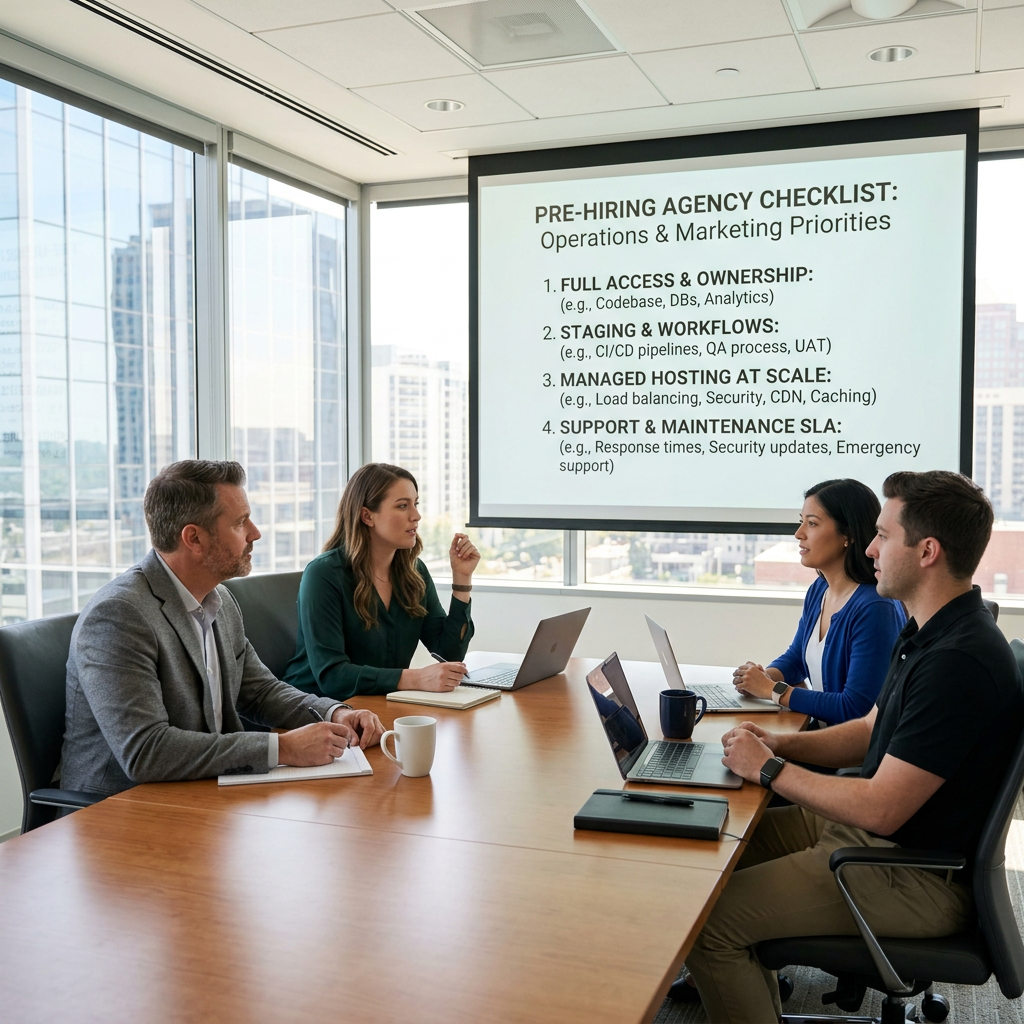
- How is multi-stakeholder access handled? Marketing needs to publish without waiting on a dev ticket. IT needs security and update visibility. Sales might need CRM data flowing in both directions. If the agency’s answer is “everyone gets admin,” that’s a red flag, not a convenience.
- What does the staging and deployment process look like? Changes should never go straight to production on a site tied to revenue. Ask to see an actual staging environment, not just hear that one exists.
- Who else understands this codebase besides our main contact? Agency bus-factor risk is real. If one developer leaving would strand your site, that’s a business continuity problem, not just a technical one.
- How does the platform handle multi-location or multi-brand structure? Multisite, custom post types, and role-based permissions all solve this differently — the right answer depends on how centralized or independent your locations or business units actually are.
- What’s the actual hosting and security posture? Managed WordPress hosting with real backups, uptime monitoring, and a patching cadence is not optional at this scale. “We host it on shared hosting” should end the conversation.
- What does support look like after launch? Get specifics: response times, whether there’s a retainer, what counts as an emergency versus a queued request.
Where WordPress Genuinely Earns Its Place at This Level
Done properly, WordPress holds up well for mid-size and larger organizations because it’s flexible about how much structure you layer on top of it. A marketing team that wants to move fast on content can have that, while IT still gets role-based access controls, audit logs, and a hosting environment that meets real security standards. It integrates cleanly with most CRM, marketing automation, and analytics stacks without custom engineering for every connection. And critically, it doesn’t lock you into one agency the way some proprietary platforms do — a well-documented WordPress site can move to a new team if the relationship doesn’t work out.
That last point matters more than most RFPs account for. The platform decision is reversible. The agency decision is what actually determines whether your team is fighting the website or using it.
What I’d Tell a Colleague Doing This Evaluation
Don’t evaluate agencies on their portfolio alone — ask to talk to a current client who’s been with them through at least one post-launch problem. How that got handled tells you more than any case study. And get the technical questions above answered in writing before you sign, not after the first incident makes you wish you had.