
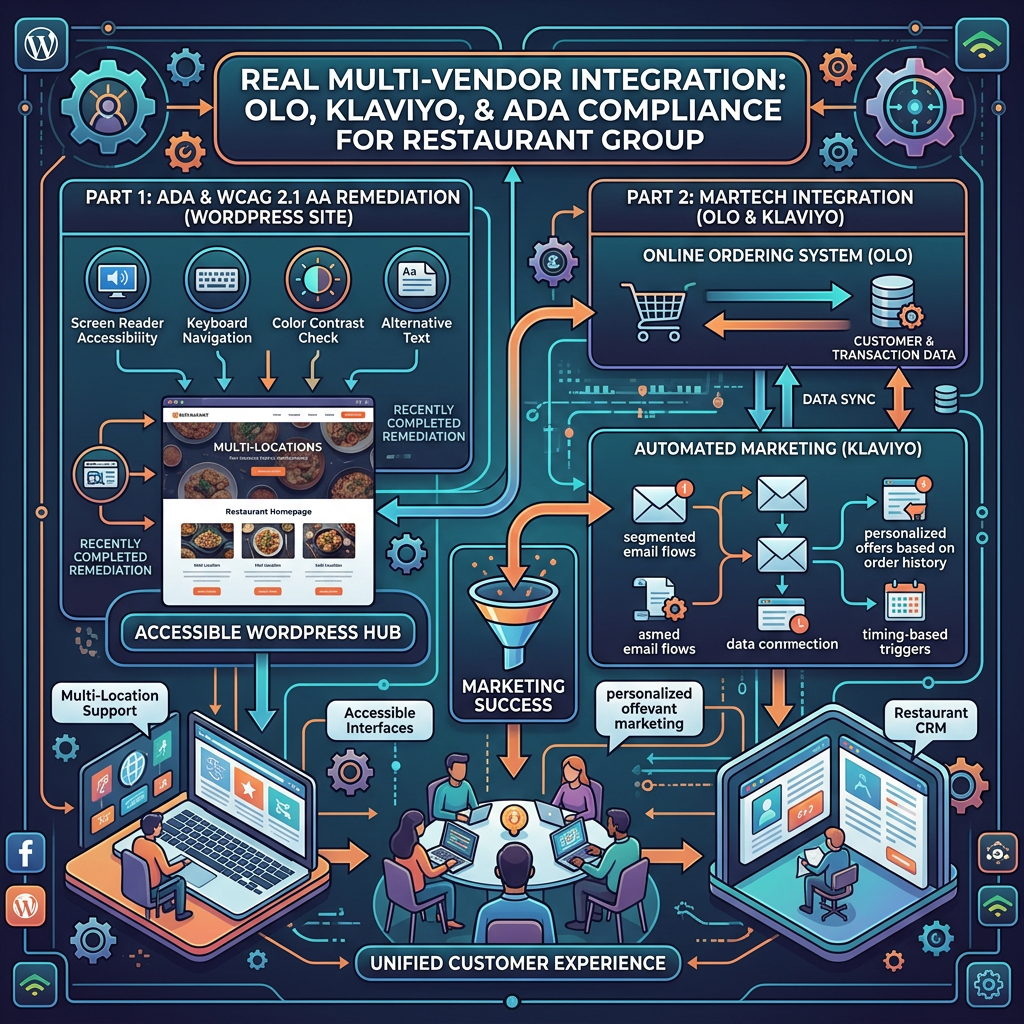
Most of what I write here is framed around what to ask before you sign with an agency. This one is a little different — it’s what that work actually looks like once it’s underway, using a real project as the example. I recently completed ADA and WCAG 2.1 AA remediation for a multi-location restaurant brand’s WordPress site, and followed that with a Martech project integrating Olo’s online ordering system with Klaviyo for automated marketing. Doing the compliance work first, then layering integrations on top of it, is a good illustration of how these pieces have to fit together rather than get bolted on separately.
The Starting Problem
The site needed ADA and WCAG 2.1 AA remediation first, before any new functionality was layered on — fixing the foundation before building on top of it. Once that work was in place, the next phase was integrating Olo’s ordering system and connecting Klaviyo for email marketing. Olo doesn’t have a native WordPress plugin — it’s typically brought into a site through its embeddable widget or API, which behaves like a third-party component dropped into the page rather than a deeply integrated WordPress feature. On paper these look like separate projects done in sequence. In practice, doing accessibility first meant every new integration afterward had to be held to the same standard rather than introduce new gaps into a site that had just been fixed. An email integration that doesn’t respect how order and customer data actually structures itself in Olo produces broken segments and bad personalization. Treating later phases as disconnected from the accessibility work that came before them is exactly how a project ends up needing to be redone.
How the Pieces Actually Connected
The ADA remediation came first and covered the whole site — the usual list of alt text, contrast, keyboard traps, form labels, and skip links — establishing a baseline the rest of the project had to hold to.
The Klaviyo integration, done alongside the Olo work, meant making sure customer and order data flowing from the site and from Olo reached Klaviyo in a form that actually supported segmentation and personalization — not just a name and email address, but the data that makes an email program worth running.
Why This Is the Right Way to Think About These Projects
When an operations manager or marketing director is evaluating an agency for a project like this, the real question isn’t whether the agency has worked with Olo, or Klaviyo, or accessibility remediation individually. It’s whether they understand the right order to do the work in — fixing the foundation before building integrations on top of it — and whether they recognize that a third-party ordering widget doesn’t automatically inherit the accessibility or performance standards of the site it’s embedded in, and has to be tested on its own terms.
What I’d Tell a Colleague Evaluating a Similar Project
Ask an agency how they’d sequence a project like this — which work happens first, and why. If accessibility isn’t treated as the foundation that later integrations get built on, that’s worth a follow-up question, because on a real project, doing it in the wrong order usually means doing some of it twice.