
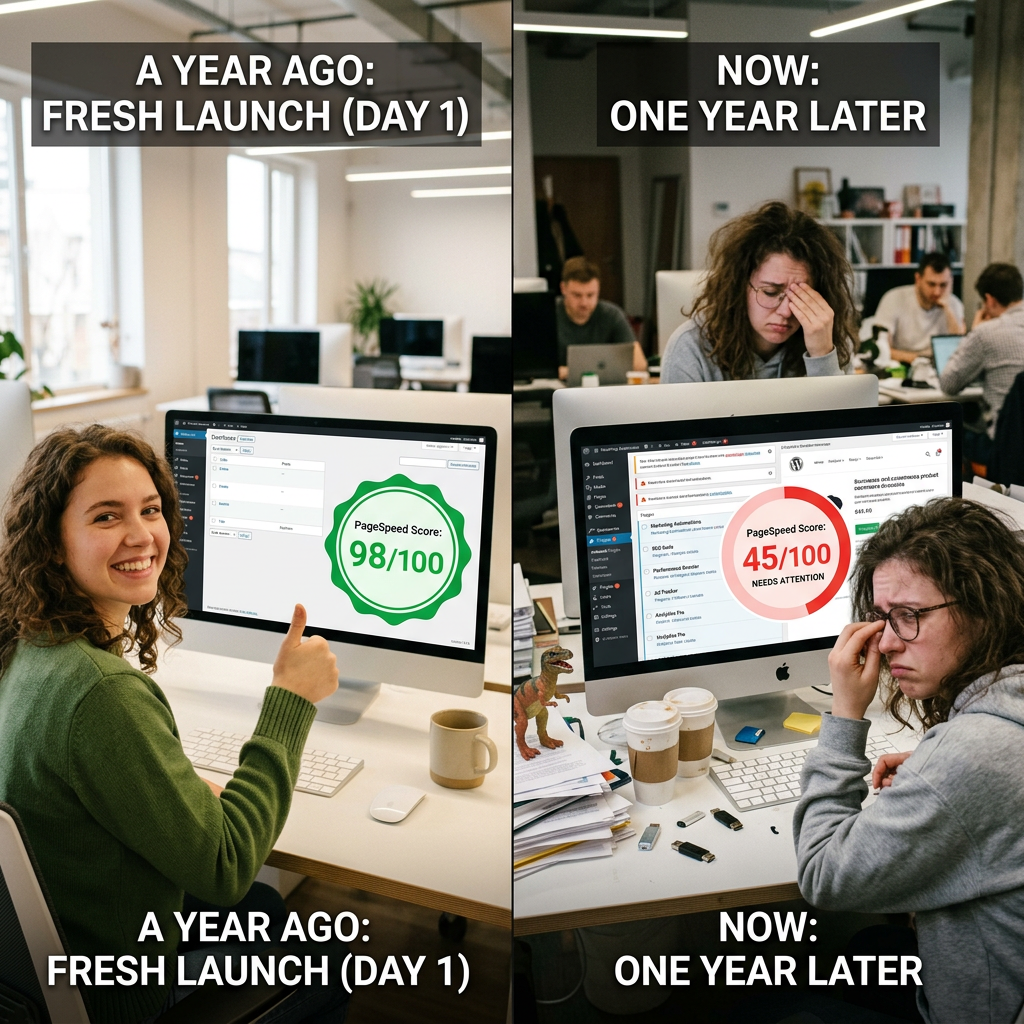
Every new WordPress site scores well on page speed at launch. Empty-ish content, a fresh cache, no real traffic — of course it’s fast. The real test comes a year later, once there are hundreds of pages, a growing product catalog, a handful of marketing plugins nobody remembers approving, and actual visitors hitting the site at once. Operations managers and marketing directors evaluating an agency should be asking about that version of the problem, not the demo version.
Why Launch-Day Speed Doesn’t Predict Much
Core Web Vitals — the metrics Google uses to judge real-world user experience, covering loading speed, interactivity, and visual stability — tend to degrade gradually as a site grows, not all at once. Every new plugin, every large image someone uploads without optimizing it, every embedded widget adds a small amount of weight. None of it looks alarming in isolation. Eighteen months in, it adds up to a site that fails Core Web Vitals thresholds without any single obvious cause, which makes it much harder to fix than a problem with one clear source.
What to Ask an Agency Before You Sign
- How do they test performance beyond launch day? Ask whether Core Web Vitals are monitored on an ongoing basis, or only checked once at handoff. A one-time score means nothing a year later.
- What’s their process for image and media optimization at scale? A manual process that depends on someone remembering to compress images breaks down as content volume grows. Ask what’s automated.
- How do they manage plugin bloat over time? Every plugin added after launch is a potential performance cost. Ask how the agency audits and prunes plugins as the site evolves, not just what’s installed on day one.
- What caching strategy is in place, and does it hold up under real traffic patterns? Ask specifically how caching handles dynamic content — a shopping cart, a personalized dashboard, a frequently updated blog — which is where generic caching setups tend to fail.
- How is third-party script weight managed? Analytics tags, chat widgets, marketing pixels, and embedded tools each add load time. Ask how the agency balances marketing’s need for these tools against their performance cost.
- What happens when Core Web Vitals scores start slipping? Ask for a concrete example of a past client site that degraded and how it got fixed, not just an assurance that it won’t happen.
- Is performance testing done on mobile, on realistic connection speeds? A site that’s fast on a developer’s desktop over fiber can be a very different experience on a phone over a mediocre connection, which is where most real traffic actually happens.
Why This Is Worth the Scrutiny
Core Web Vitals are a confirmed ranking factor, and beyond SEO, slow pages measurably hurt conversion rates — the gap between a fast site and a slow one shows up directly in how many visitors complete a purchase, fill out a form, or make a call. A site that degrades quietly over eighteen months can cost real revenue before anyone traces the drop back to performance, which is exactly why this needs an ongoing process rather than a one-time launch check.
What I’d Tell a Colleague Making This Call
Ask to see real Core Web Vitals data from a client site the agency has maintained for at least a year or two, not a fresh launch. A site that’s held up well over time under real content growth tells you far more about an agency’s actual practices than any number from a brand-new build.