
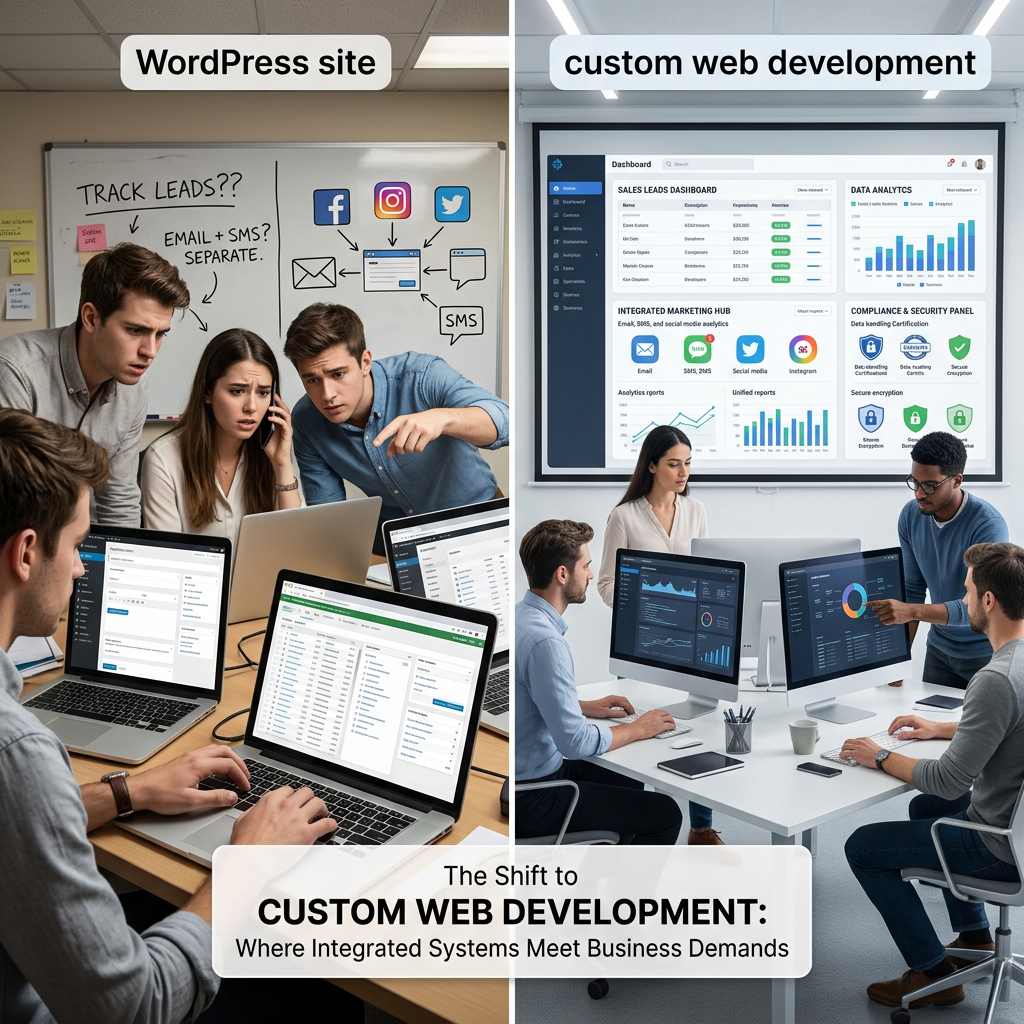
Most companies start with a themed WordPress site, and for a while that’s genuinely enough. The point where it stops being enough is usually quiet and specific: a sales team needs leads tracked somewhere real, marketing needs email and SMS and social working as one system instead of three disconnected ones, or the business just has requirements — security, compliance, data handling — that a template was never built to satisfy. That’s the point where “custom web development” stops being a buzzword and starts being the actual ask.
What “Custom” Should Actually Mean
I think about custom web development as four overlapping areas, and most projects touch more than one at once.
- CRM — tracking leads, consolidating customer data across the lifecycle, and giving sales and marketing a shared, accurate picture instead of two different spreadsheets that disagree with each other.
- Omnichannel marketing — connecting email automation, SMS, and social messaging into one system so a customer’s experience is consistent whether they came in through an ad, an email, or a text.
- Security requirements — protecting customer data, which isn’t optional once a business has real legal exposure, financial risk, and a reputation to protect, on top of the search ranking damage a breach or a flagged site can cause.
- E-commerce — automated, connected workflows for accounting, inventory, fulfillment, marketing, and payment processing, rather than a storefront that technically works but needs a person to patch the gaps between systems by hand.
None of these are separate projects in practice. A CRM that isn’t connected to the marketing automation tools isn’t doing its job. An e-commerce workflow that doesn’t feed accounting creates a reconciliation headache every month. The value is in how these pieces connect, not in any one of them existing in isolation.
What’s Actually Under the Hood
On the technical side, this work typically spans WordPress and WooCommerce at the platform level, PHP and JavaScript for custom functionality, REST APIs to connect everything together, and payment processing through Stripe, WooPayments, or PayPal. On the marketing and CRM side, that might mean HubSpot, Mailchimp, Constant Contact, Klaviyo, or similar platforms, wired in through their APIs rather than a shallow plugin connection. The specific stack matters less than whether the agency can explain why each piece was chosen for your situation rather than because it’s what they always use.
How This Kind of Project Should Run
A custom build should move through three distinct phases: discovery, where the actual business needs and objectives get mapped before any code gets written; development, where functionality gets built and integrated against that foundation; and optimization, where SEO and user experience get refined based on how the site is actually performing, not just how it looked at launch. Skipping discovery is the most common shortcut I see, and it’s the one that costs the most later — a build that starts with a template and features bolted on tends to need significant rework once the real requirements surface.
What to Ask an Agency Before You Sign
- What does their discovery process actually involve? Ask for specifics — stakeholder interviews, current-system audits, documented requirements — not just a kickoff call.
- Which of these four areas have they built before, and can they show it? A agency that’s done CRM integration well isn’t automatically equipped for e-commerce automation, or vice versa.
- How do the systems stay connected after launch? APIs change, platforms get upgraded. Ask who owns keeping these integrations working over time.
- What’s included after launch? Ask specifically what post-launch support covers and for how long, and what happens once that period ends.
What I’d Tell a Colleague Making This Call
Write down the specific manual workaround that made you start this conversation — the spreadsheet, the double data entry, the marketing channel that doesn’t talk to the others. That’s the clearest test of whether a proposed solution actually solves your problem, or just sounds impressive in a sales deck.