
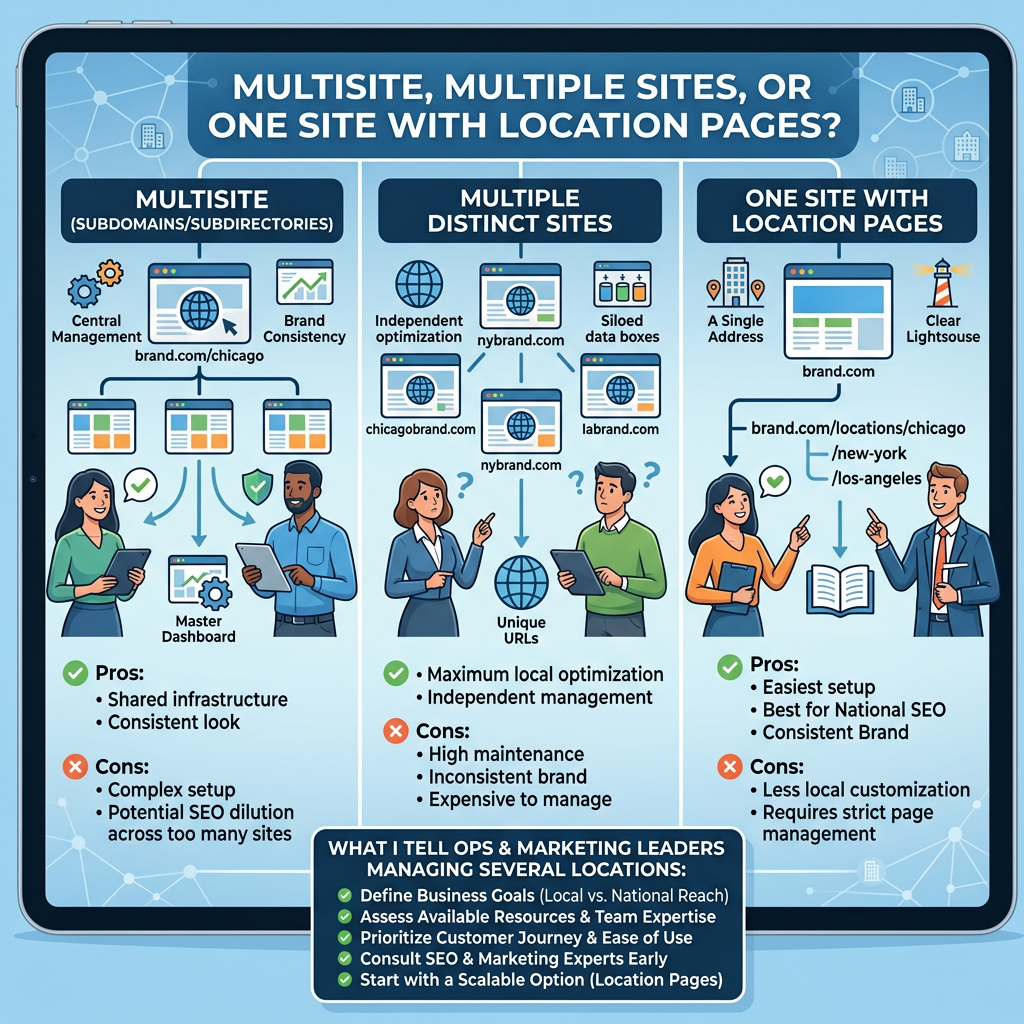
Almost every company with more than one location or brand asks me the same question eventually: should each one get its own website, or should everything live under one roof? There’s no single right answer, but there is a wrong way to decide it — picking a structure before you’ve mapped out who actually needs to control what.
The Three Structures, and Who They’re Actually For
There are three real options, and each one solves a different organizational problem more than a technical one.
- WordPress Multisite — one codebase, one login, multiple sites sharing plugins and themes. Best when locations or brands are closely related and a central team manages most of the content, with light local customization.
- Separate WordPress installs — fully independent sites, each with its own hosting, plugins, and admin access. Best when brands genuinely operate independently, need different functionality, or might be sold or spun off separately down the line.
- One site with location or brand pages — a single site structured with a location or brand taxonomy, custom post types, or a directory-style layout. Best when the differences between locations are mostly informational — address, hours, staff — rather than structural.
The mistake I see most often is choosing multisite because it sounds efficient, then discovering that one franchise location wants a completely different page layout, or that a legal team needs one brand fully isolated from another for liability reasons. Multisite makes that kind of divergence painful. It also makes it easy for a plugin update on one site to break every site in the network at once, which is a bigger deal at ten locations than at two.
What to Ask an Agency Before Committing to a Structure
- How much local control does each location actually need? If local managers just update hours and photos, that’s a very different setup than local managers running their own promotions and blog content.
- What happens when one location wants something the others don’t? Get a real answer about how the agency handles divergence — not just for today’s locations, but for the location you’ll open next year.
- How is SEO handled across locations? Duplicate content across near-identical location pages can hurt rankings if it’s not structured correctly. Ask specifically how they’ll differentiate location pages for search.
- What’s the plan if a brand or location needs to separate later? Acquisitions, divestitures, and franchise buyouts happen. Ask how painful it would be to split a site out of a multisite network if that day comes.
- Who has admin access, and how is that controlled? Local managers, corporate marketing, IT, and the agency all need different levels of access. A structure that can’t express that cleanly creates ongoing friction.
- How are shared assets — logos, brand guidelines, legal boilerplate — kept in sync? This matters whether it’s one site or twenty; ask what breaks first when a brand refresh happens.
Where I’d Start
Before picking a structure, get honest about how independent your locations or brands actually are today, and how independent they’re likely to become. A structure built around today’s org chart can get expensive to unwind later if that chart changes — and in my experience, it usually does.