
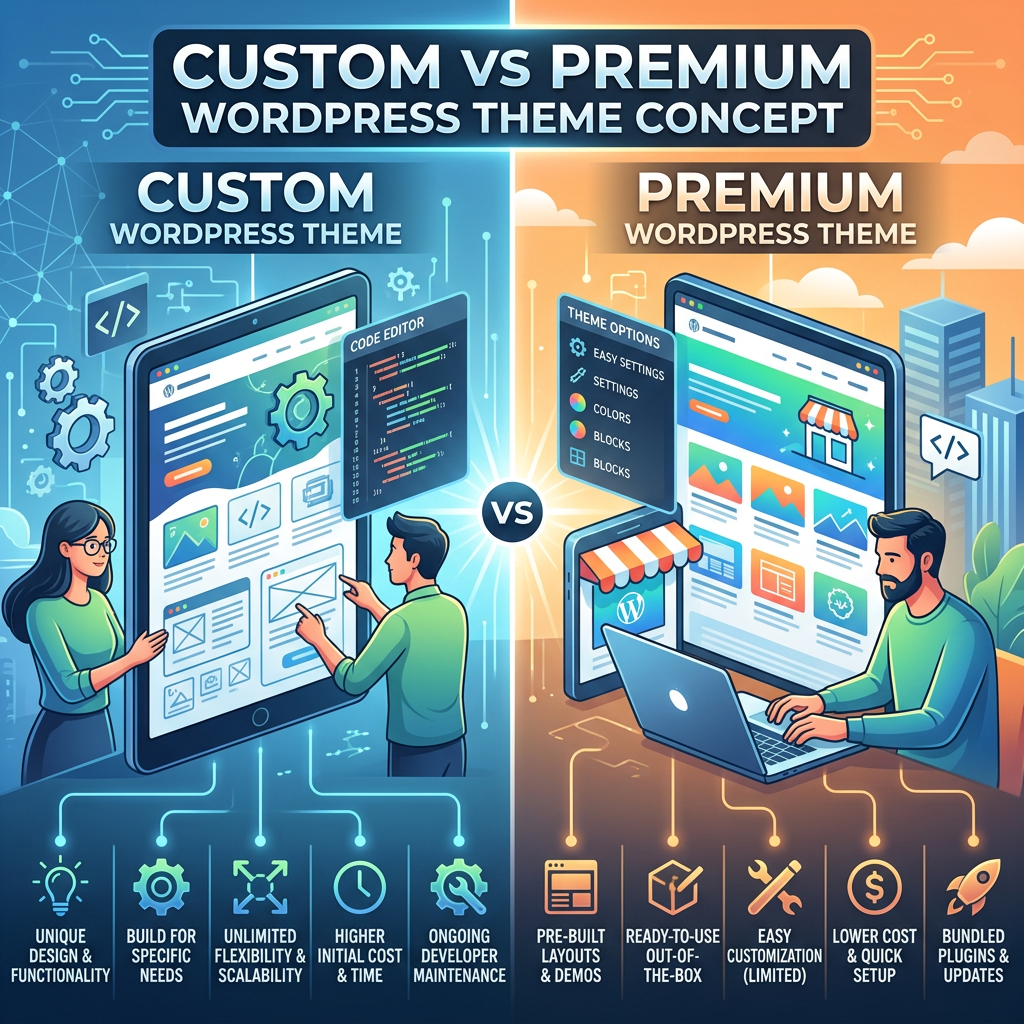
It’s one of the first decisions that comes up when planning a new WordPress site: do you need a fully custom theme, or will a good premium theme get the job done? The honest answer depends on your business — but most people don’t have a clear picture of what they’re actually choosing between. Here’s how to think about it.
What a Premium Theme Actually Is
Premium themes are pre-built WordPress templates sold on marketplaces like ThemeForest or directly by developers. You buy it, install it, load up a demo, swap in your logo and colors, add your content, and you have a website. The appeal is obvious — faster, cheaper, done.
The better premium themes — Divi, Astra, GeneratePress, Kadence — are genuinely well-built. They’re flexible, actively maintained, and used by millions of sites. For certain use cases, they’re completely appropriate.
But a theme is still a template. It was designed for a hypothetical business, not yours. Which means you’re adapting your content and layout to fit what the theme can do, rather than building around what your business actually needs.
Where Premium Themes Work Well
A premium theme is probably fine if your needs are straightforward. A simple service business site — four or five pages, a contact form, some photos of your work — doesn’t necessarily need a custom build. If the theme covers the layout you need and you’re not trying to do anything unusual, the flexibility trade-off isn’t that painful.
It also makes sense when budget is genuinely tight and getting something live quickly matters more than getting something perfect. A well-configured premium theme beats a delayed custom build sitting in development limbo.
Where They Fall Short
The limitations show up fast once you have specific requirements. That layout you need that’s slightly different from any of the theme’s demos? You’re fighting the template. The custom functionality your sales process requires? Probably a plugin bolted on top of a plugin. The specific visual identity your brand needs? Approximated, not realized.
Performance is a real concern too. Many premium themes — particularly the feature-heavy ones — load a lot of CSS and JavaScript whether you’re using those features or not. All that unused code adds weight to every page. Sites built on bloated themes often struggle with Core Web Vitals scores regardless of how much other optimization you do.
And then there’s the look. Premium themes are popular precisely because they look good to a lot of people. Which also means a lot of businesses are using the same ones. If you’ve ever landed on a site and felt a faint sense of recognition — like you’ve seen this layout somewhere before — that’s exactly this problem. Your brand is supposed to be distinctive. A widely-used template works against that.
What Custom Actually Means
A custom WordPress theme is built from scratch — or from a minimal starter — specifically for your business. The design reflects your brand, not a template. The code only includes what your site actually needs, which makes it leaner and faster. The layout isn’t a compromise between what the theme can do and what you want — it’s just what you want.
Custom builds take longer and cost more. That’s the real trade-off. But what you get in return is a site that’s genuinely yours — faster, more distinctive, easier to maintain long-term, and built around how your business actually works rather than how a theme developer imagined a generic business might work.
The Upgrade Path Problem
A lot of businesses start with a premium theme because it’s cheaper, then hit a wall 18 months later when they need something the theme can’t do. At that point, you’re either paying a developer to hack around the theme’s limitations — which gets expensive and messy fast — or you’re rebuilding anyway, having already spent money on the first version.
If you can see that wall coming, building custom from the start is usually the better financial decision over a three-year horizon, even if it costs more upfront.
A Practical Way to Decide
Ask yourself a few honest questions:
- Does my site need to do anything a standard template doesn’t obviously support?
- Is visual differentiation from competitors important in my market?
- Am I planning to grow this site significantly over the next two or three years?
- Does site speed matter for my conversions or SEO strategy?
- Is my brand strong enough that a generic template would feel like a step down?
If you answered yes to two or more of those, a custom build is probably the right call. If your needs are simple and your timeline is short, a well-chosen premium theme with careful configuration can work.
What We Do
At Interactive Design Group, we build custom WordPress sites. We don’t start from premium themes because the flexibility they seem to offer up front creates limitations and technical debt that clients run into later. Our builds start lean and are designed specifically around each client’s business.
If you’re trying to figure out what the right approach is for your project, get in touch. We’ll give you a straight answer based on what you’re actually trying to build.