
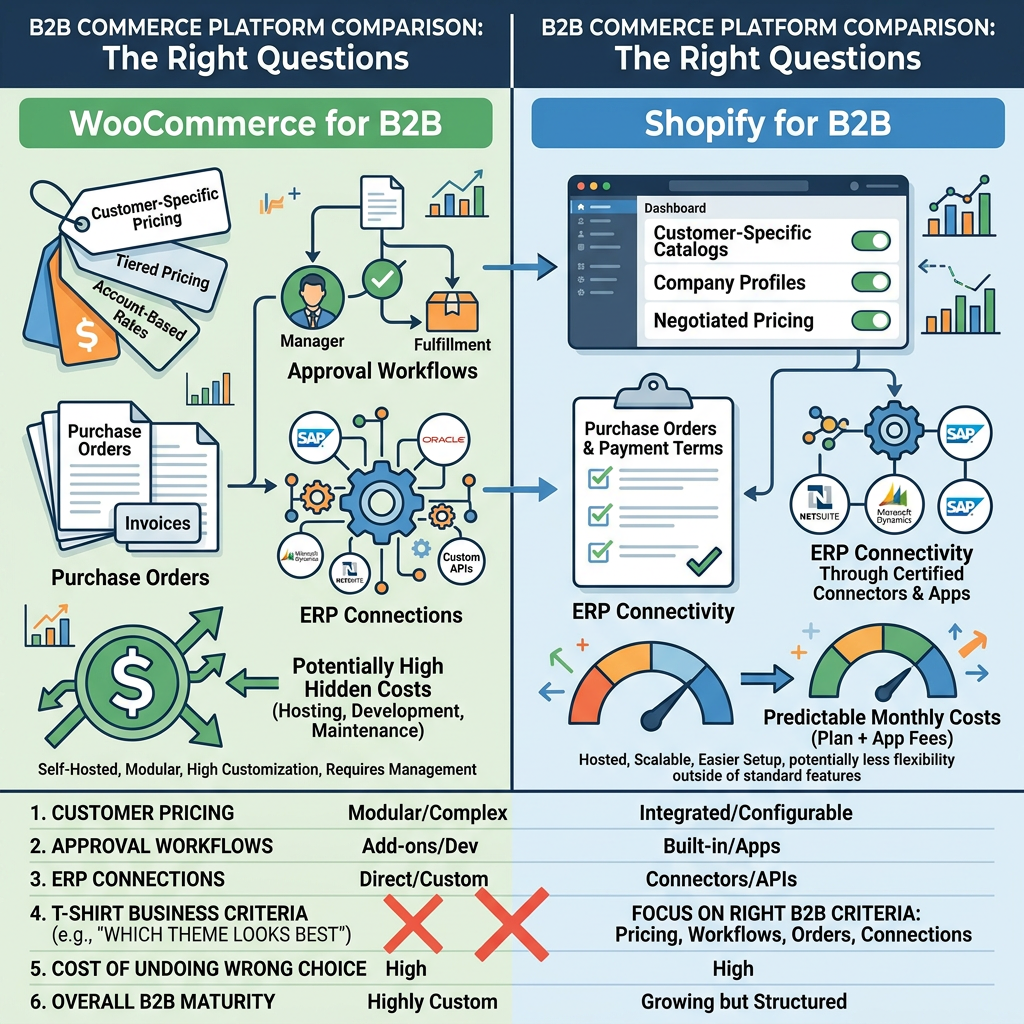
Most WooCommerce versus Shopify comparisons are written for a company selling t-shirts to consumers. If your business sells to other businesses, the questions change. Customer-specific pricing, approval workflows, purchase orders, and ERP connections matter far more than which theme looks best. Choosing a platform on the wrong criteria is expensive to undo, so it is worth asking the right questions before you commit.
Why B2B Changes the Decision
B2B buyers do not shop the way consumers do. They reorder the same items, expect negotiated pricing, need to buy on account, and often have several people involved in a single purchase. A platform that handles a simple consumer checkout well can still struggle with these patterns, or can handle them only through add-ons that carry their own cost and limits.
Where the Two Platforms Differ
- Flexibility: WooCommerce runs on WordPress and can be customized at the code level, so unusual pricing rules, quoting, and ordering flows can be built to match how your business works. Shopify is faster to launch and more standardized, which is an advantage until your process does not fit its model.
- Cost structure: Shopify charges a subscription and often additional fees for apps and transactions. WooCommerce has no platform subscription, but you pay for hosting, maintenance, and development. Compare total cost over several years, not the launch price.
- Ownership and control: With WooCommerce you own the code, the data, and the hosting environment. On a hosted platform, you work within the rules and limits of the provider.
- Integrations: Both connect to common tools, but the depth varies. If your ERP, CRM, or inventory system needs a two-way connection, ask exactly how it will be built and who maintains it.
- Content and SEO: WordPress is a strong publishing platform, which helps when organic search drives your leads and your catalog needs supporting content.
When Shopify Is the Better Fit
Shopify is a reasonable choice when your catalog is straightforward, your pricing is largely uniform, and speed to launch matters more than customization. It also suits teams with no technical support who want the platform provider to handle hosting and security. An honest agency will tell you when it is the right answer, even if it does not build on it.
When WooCommerce Is the Better Fit
WooCommerce tends to win when ordering rules are complex, when the store has to connect deeply with internal systems, or when the site is also a major source of organic leads. It asks more of you in planning and maintenance, which is why the agency behind it matters as much as the platform itself.
Questions to Ask Before You Choose
- How will customer-specific pricing and account ordering work? Ask for a demonstration, not a feature list.
- Which of these requirements need paid apps or custom code? Get the ongoing cost of each in writing.
- How will the store connect to our ERP, CRM, and inventory systems? Ask who fixes it when a connection breaks.
- What does this cost over three to five years? Include hosting, apps, maintenance, and development.
- If we outgrow this setup, what does leaving look like? Find out what data and code you would be able to take with you.
Choose the Platform After You Define the Process
The platform should follow your ordering process, not the other way around. Write down how your best customers buy today, what your team needs to manage, and which systems must stay connected. Then ask each agency to show how its recommended platform handles those specifics.
Where to Start
If you are weighing platforms now, I am glad to walk through your requirements and tell you plainly which fits. You can see what I build on my WooCommerce solutions page, and my managed hosting and maintenance plans show what ongoing support looks like once the store is live.