
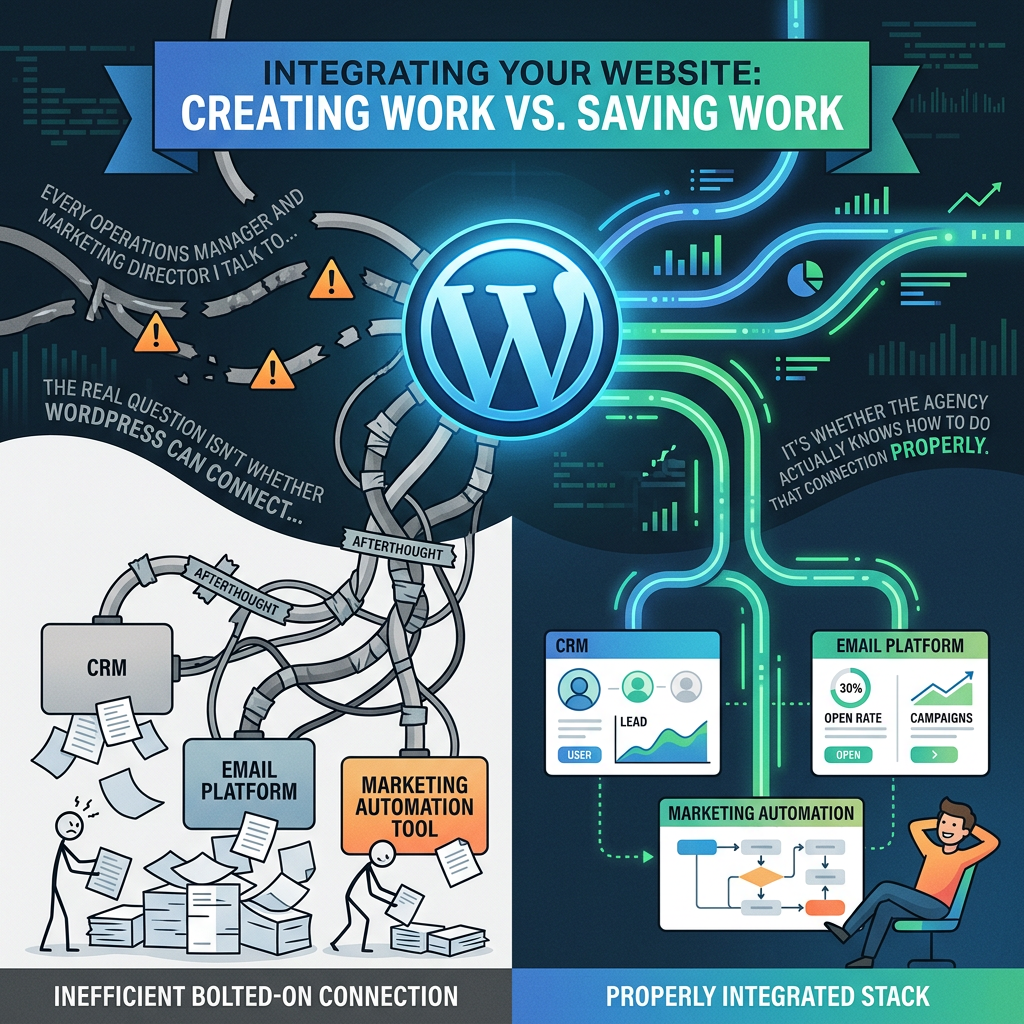
A website that doesn’t talk to the rest of the marketing and sales stack is a website that creates work instead of saving it. Every operations manager and marketing director I talk to has some version of this stack already in place — a CRM, an email platform, maybe a marketing automation tool — and the real question isn’t whether WordPress can connect to it. It’s whether the agency building the site actually knows how to do that connection properly, or whether it’s an afterthought bolted on after launch.
Where This Usually Goes Wrong
The most common failure isn’t a total lack of integration — it’s a shallow one. A form plugin gets connected to the CRM just well enough to pass a name and email address, while everything else that matters — lead source, campaign attribution, custom fields the sales team actually uses — gets dropped along the way. Nobody notices until someone in sales asks why half their leads show up with no context.
The second most common failure is a brittle one-off integration built by whoever happened to be on the project, with no documentation and no plan for what happens when an API changes or a field gets renamed on either side.
What to Ask an Agency Before You Sign
- Have they actually built this integration before, with your specific tools? CRM and marketing automation platforms all handle data differently. Ask for a real example, not a general statement that “WordPress integrates with everything.”
- What data actually flows, and in which direction? Get specific: form submissions to the CRM, sure — but also, does customer status or lifecycle stage flow back to the site to personalize content? Ask what’s actually being built versus what’s technically possible.
- How is the integration maintained? APIs change, fields get renamed, authentication tokens expire. Ask who’s responsible for keeping the connection working over time, and what happens when it breaks.
- Where does the data actually live, and who owns it? If the agency’s approach depends on a third-party middleware tool, understand what happens to that data flow if you ever change agencies.
- How is attribution and campaign data preserved? If marketing needs to know which campaign, ad, or content piece generated a lead, that data has to be captured and passed through intact — ask specifically how.
- What’s the fallback if the integration fails? A form that silently fails to reach the CRM is worse than one that visibly errors out. Ask how failures are caught and who gets alerted.
- Does this respect the CRM’s existing data structure? An integration that creates duplicate contacts, ignores existing custom fields, or fights with your CRM’s automation rules will cause more cleanup work than it saves.
What a Good Integration Actually Looks Like
Data flows both ways where it needs to, mapped explicitly to the fields your teams actually use — not just the ones that happen to be easy. Attribution data survives the trip from an ad click to a CRM record. Someone owns the integration’s health after launch, with monitoring in place to catch failures before a sales rep notices missing leads. And the whole thing is documented well enough that it doesn’t depend on one person’s memory.
What I’d Tell a Colleague Making This Call
Bring your actual CRM admin or marketing ops person into the vetting conversation, not just IT and marketing leadership. They’re the ones who’ll notice immediately if lead data is incomplete or attribution is broken, and they’ll ask questions a general web agency pitch usually doesn’t answer upfront.